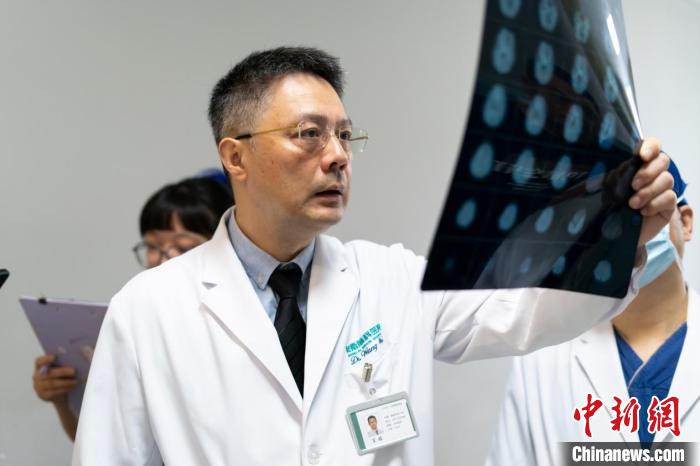
Dr. Wang Wei reviewing imaging during evaluation of a cerebral vascular patient at Shanghai Donglei Brain Hospital. (Image: China News Service)
In This Article
Golden Age, Sudden Brain Blood Flow Interruption
At 38, Batel (a pseudonym), a Mongolian man working in China, was in what many consider the prime of life. One month before admission, he suddenly felt dizzy and weak. Imaging results were alarming: his right middle cerebral artery was completely occluded.
The middle cerebral artery is one of the brain's most important "main water pipes." Dr. Wang Wei, Director of Neurosurgery at Shanghai Donglei Brain Hospital, explains: "It supplies oxygen and nutrients to the brain's core functional areas — the frontal lobe, parietal lobe, and most of the temporal lobe. These regions control limb movement, language expression, sensory perception, and even memory."
"Middle cerebral artery occlusion is most common in middle-aged and older patients with hypertension, hyperglycemia, and hyperlipidemia. However, although the proportion of young patients like Batel is not as high, it is gradually increasing."
Dr. Wang noted that long-term unhealthy diet, lack of exercise, stress, smoking, and family history are important risk factors. The two main culprits behind occlusion are thromboembolism and severe atherosclerosis. In Batel's case, the primary cause was atherosclerosis.
The Brain's Major Artery and Stroke Mechanism
Treatment of middle cerebral artery occlusion mainly includes medication, thrombolysis during the ultra-acute phase, and surgery. The main goal of surgery is to rebuild blood flow and prevent tissue ischemia or necrosis caused by vascular blockage.
🔬 Why the Middle Cerebral Artery Matters
- Largest branch of the internal carotid artery and the most common site of stroke.
- Supplies motor and sensory areas for the face, arm, and hand on the opposite side of the body.
- Language centers (Broca's and Wernicke's areas) depend largely on MCA perfusion.
- Complete occlusion can cause large-territory infarction with severe disability.
At Shanghai Donglei Brain Hospital, Batel underwent comprehensive examination and evaluation. Cerebral angiography clearly showed that the main trunk of the right middle cerebral artery was completely occluded. After discussion, Dr. Wang Wei's team formulated a surgical plan for craniocerebral-intracranial vascular reconstruction.
Indirect Revascularization With Temporal Muscle Patch
During surgery, the team encountered a challenge: because the vessel had been occluded for a long time, the original vessel function had degenerated, and many tiny collateral vessels had proliferated. Dr. Wang used a vivid analogy: "It was like an old, abandoned main road, surrounded by barely passable narrow paths. In this situation, we could not find a suitable cortical vessel for direct bypass, so we chose one of the craniocerebral-intracranial vascular reconstruction techniques — the temporal muscle patch procedure."
During the operation, the team carefully detached a section of muscle from the patient's temporal region. This muscle lies close to the brain and itself has a very rich blood supply network. The muscle tissue, carrying its living vascular network, was then placed precisely over the most ischemic and hypoxic area of the brain surface, like a "patch."
How the temporal muscle patch works:
- The muscle receives blood from the external carotid artery system.
- Placed on the brain surface, it continuously stimulates the ischemic tissue beneath it.
- This stimulation induces the growth of new blood vessels.
- Over time, a new effective collateral circulation pathway forms.
"Like on dry land, using abundant water nearby to naturally 'seep' out new irrigation channels. This is an indirect blood flow reconstruction method that is safe and effective," Dr. Wang explained.
The surgery was completed smoothly under the skilled hands of Dr. Wang Wei's team. Postoperatively, Batel recovered well. Encouragingly, the function of his previously weak right hand gradually improved, and his language expression became clearer and more fluent. "I can feel my strength coming back!" Batel expressed his gratitude in increasingly fluent Chinese. After careful nursing, he was discharged smoothly.
"Thank you very much! When I needed help most, it was the professional Chinese medical team that gave me a second life."
Recovery and Follow-Up Plan
Batel has returned to work. He needs to follow medical advice and return for follow-up examinations. At 3 months, he will undergo a cranial MRI to assess the preliminary establishment of the new vascular network. At 6 months, he will undergo a cerebral angiography (DSA) to visually evaluate the maturity of the new vessels and the improvement of blood flow.
Patient Age
Artery
for Neovascularization
for Flow Assessment
This new "lifeline" nurtured by the temporal muscle will silently nourish his brain, supporting him to continue striving for life and his dreams.
Preventing Stroke and Vascular Occlusion
Batel's case is also a warning: stroke (commonly known as "brain attack") is no longer the exclusive disease of the elderly; it is becoming increasingly common in younger people.
⚠️ High-Risk Groups for Cerebral Vascular Occlusion
- People with chronic diseases such as hypertension, diabetes, and hyperlipidemia.
- Those with a family history of stroke or cardiovascular and cerebrovascular disease.
- Long-term smokers and heavy drinkers.
- People who are obese, physically inactive, or under long-term mental stress.
- People with unhealthy eating habits.
Dr. Wang Wei emphasizes that the key to defending the brain is prevention:
Stroke prevention essentials:
- Strictly manage the "three highs": Take medications as prescribed, regularly monitor blood pressure, blood sugar, and blood lipids, and ensure they reach target levels.
- Quit smoking and limit alcohol: Tobacco is a "corrosive" to blood vessels, and excessive alcohol is also harmful.
- Stay active: Ensure at least 150 minutes of moderate-intensity exercise per week.
- Eat healthily: Eat more vegetables, fruits, and whole grains; choose white meat; use good vegetable oils; and control salt and sugar intake.
- Screen regularly: People over 40, especially those with risk factors, should undergo carotid ultrasound, transcranial Doppler (TCD), or head-neck CTA/MRA to assess cerebrovascular health.
🏆 A New Lifeline for a Young Patient
Batel's successful treatment demonstrates the value of craniocerebral-intracranial vascular reconstruction for patients with complex cerebral artery occlusion. Through careful evaluation, precise indirect revascularization, and comprehensive postoperative care, the team at Shanghai Donglei Brain Hospital gave this young Mongolian patient a second chance at a full life.
For international patients seeking evaluation for stroke treatment, cerebral vascular reconstruction, or second opinions on complex neurovascular conditions, the hospital provides comprehensive consultation services with multilingual support.
Seeking Stroke Treatment Options?
Our international patient team offers free preliminary consultations, treatment planning, and travel coordination for overseas patients considering neurovascular surgery or stroke care in Shanghai.