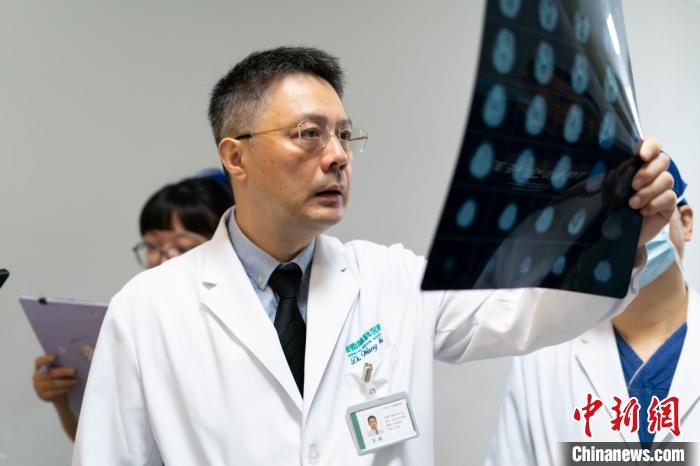
Dr. Wang Wei reviewing imaging during evaluation of a post-stroke hemiplegia patient at Shanghai Donglei Brain Hospital. (Image: China News Service)
In This Article
A Sudden Stroke, Three Years of Struggle
Three years ago, Mr. Wei (a pseudonym), a man in his forties, suffered a sudden hypertensive brainstem hemorrhage. The bleeding damaged critical neural pathways, leaving him with hemiplegia on one side of his body.
For the next three years, his life changed completely. He lost the ability to walk independently, needed family support to stand or turn, could no longer work, and required daily assistance with basic activities. Despite trying multiple rehabilitation therapies, his progress plateaued and his family began to lose hope.
"I thought my life was over. I couldn't walk, I was a burden to my family, and I was suffering every day. I never imagined I would be able to stand up again."
What Is Vagus Nerve Stimulation?
The vagus nerve is one of the longest cranial nerves. It originates in the brainstem and travels down through the neck, chest, and abdomen, connecting the brain to the throat, heart, digestive tract, and other organs. Some of its fibers run upward from the neck back into deep brain structures, linking to neurons and nuclei that control movement, mood, and autonomic function.
Vagus Nerve Stimulation (VNS) is a minimally invasive neuromodulation procedure in which a flexible electrode is wrapped around the vagus nerve in the neck and connected to a small pulse generator implanted under the skin of the chest. The device delivers gentle electrical impulses that travel through the vagus nerve toward the brain, helping to regulate neural activity and improve motor control.
🔬 How VNS Supports Stroke Recovery
- Increases cerebral blood flow: Stimulation can promote blood circulation in affected brain regions.
- Enhances neurotransmitter release: Helps restore chemical signaling pathways damaged by stroke.
- Modulates neuronal activity: Promotes neuroplasticity and rewiring of motor circuits.
- Improves balance and movement: Reduces abnormal muscle tone and tremor in hemiplegic limbs.
- Supports rehabilitation: Combined with physical therapy, VNS can accelerate functional recovery.
Dr. Wang Wei explains that VNS is one of the most advanced applications of brain-computer interface (BCI) neuroregulation technology currently used in clinical practice. It is especially promising for patients with post-stroke motor dysfunction who have not responded adequately to conventional rehabilitation alone.
Surgery and One-Week Recovery
Mr. Wei was evaluated at the outpatient clinic of Dr. Wang Wei, a neurosurgical attending specialist at Shanghai Donglei Brain Hospital. After reviewing his medical history, imaging, and functional status, Dr. Wang concluded that Mr. Wei was an excellent candidate for VNS.
During the procedure, Dr. Wang Wei carefully identified the vagus nerve and the ansa cervicalis (cervical loop) to avoid injury. He then wrapped a flexible electrode smoothly around the vagus nerve in the neck and implanted the pulse generator beneath the skin of the chest.
Procedure highlights:
- Minimally invasive surgery with a small neck and chest incision
- Precise nerve identification to protect adjacent structures
- Electrode wrapped gently around the vagus nerve
- Pulse generator placed subcutaneously in the chest
Approximately one week after surgery, the VNS pulse generator was activated. Dr. Wang Wei programmed the stimulation parameters. Throughout the process, Mr. Wei experienced no adverse reactions.
Working with the hospital's rehabilitation team, Mr. Wei then underwent one week of combined VNS neurostimulation and targeted rehabilitation exercises. By the time he was discharged, his balance and motor function had improved significantly. He could walk independently and turn around on his own.
"Although VNS has shown remarkable therapeutic effects, every patient's condition and physical status are different. Personalized treatment planning is essential."
Who Can Benefit From VNS?
Stroke is one of the leading causes of long-term disability worldwide. According to clinical data, approximately 75% of stroke survivors experience lasting after-effects, and limb motor impairment is the most common complication.
Experience After-Effects
Limb Motor Dysfunction
to See Gains
Neuroregulation
For patients like Mr. Wei, who have persistent hemiplegia despite months or years of rehabilitation, VNS offers a new pathway to recovery. Candidates are typically evaluated based on:
🧠 VNS Candidacy Considerations
- Time since stroke: Often chronic patients (months to years post-event) with stable neurological status
- Motor deficit: Partial limb weakness with some preserved movement
- Rehabilitation history: Prior standard rehab with limited functional improvement
- Overall health: Fit enough for a minor surgical procedure
- Commitment: Willingness to continue rehabilitation after device activation
The Donglei Team Behind the Milestone
This successful case reflects the integrated strength of Shanghai Donglei Brain Hospital: a neurosurgery + neurology + rehabilitation team working together to deliver individualized care.
Dr. Wang Wei is one of the hospital's senior neurosurgical specialists, with deep expertise in cerebrovascular disease, neurotrauma, and functional neurosurgery. Under the leadership of Prof. Song Donglei, the hospital has built a multidisciplinary platform that combines precise diagnosis, advanced surgical techniques, and post-operative rehabilitation.
🏆 A New Chapter for Stroke Survivors
Mr. Wei's story is a powerful example of how neuromodulation technologies like VNS can reopen doors for patients who thought their recovery had reached its limit. Shanghai Donglei Brain Hospital continues to explore the frontiers of brain-computer interface neuroregulation to help more patients regain mobility and independence.
For international patients seeking evaluation for post-stroke rehabilitation, VNS candidacy, or other neurosurgical treatments, the hospital provides comprehensive consultation services with multilingual support.
Seeking Stroke Recovery Options?
Our international patient team offers free preliminary consultations, treatment planning, and travel coordination for overseas patients considering VNS or neurorehabilitation in Shanghai.