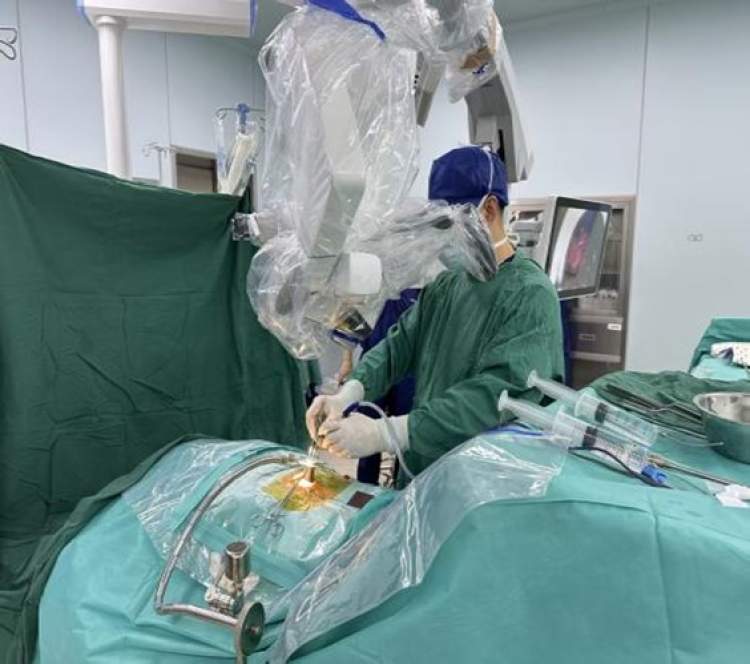
Dr. Zhang Xuejun's team performs channel-assisted minimally invasive spinal tumor surgery at Shanghai Donglei Brain Hospital.
Abnormal Skin
Sensations
Traditional Open
Incision
the Thoracic
Spine
After Channel
Surgery
Two Months of "Just Back Pain" Turned Serious
For the patient — a woman we will call Ms. Shi — it began like an ordinary ache. For two consecutive months her lower back and upper back felt seized, with the pain spreading to her right lower limb. A lumbar MRI at a local hospital showed lumbar degenerative changes and an intraspinal, extramedullary occupying lesion, most likely a schwannoma. At a well-known hospital's neurosurgery department she was diagnosed with an intraspinal thoracic schwannoma and told she needed traditional open surgery — a "big cut" that would mean severe tissue trauma and could "injure tendons and bones." Unwilling to accept that, her family learned that Dr. Zhang Xuejun at Shanghai Donglei Brain Hospital had treated many similar conditions with minimally invasive techniques, and they came to Donglei for a consultation and surgery.
"At first I thought I was just overworked — ordinary lower back and back pain that would get better with rest. But it didn't; it only got worse, extending to my lower back and legs."
At Shanghai Donglei Brain Hospital, Dr. Zhang Xuejun, attending expert in neurosurgery and spine–spinal-cord surgery, performed a channel-assisted microsurgical resection of the spinal schwannoma, and the operation went smoothly. Postoperatively Ms. Shi's pain markedly eased and the electric-shock-like pain disappeared.
What Is a Spinal Schwannoma?
A schwannoma (also called a neurilemmoma) is a benign tumor that arises from the nerve sheath. It occurs in the peripheral nervous system and is one of the most common neurogenic tumors; it can appear anywhere in the body and is frequently found in the spinal canal, mostly in the cervical and thoracic segments. Schwannomas grow slowly and often cause no symptoms early on. An intraspinal schwannoma may at first produce only mild pain; later it progressively compresses nerves, causing numbness, leg weakness, and even bowel and bladder dysfunction. Left untreated, as the tumor enlarges it can compress the spinal cord, leading to paralysis and even affecting breathing and heartbeat — a threat to life.
Key point: A schwannoma is benign, but "benign" does not mean "harmless." Its danger lies in where it grows.
Why the "Gentle" Tumor Is Dangerous
Dr. Zhang explains that because a schwannoma is benign, its slow growth often lulls patients into a false sense of security. But once it grows large enough, it damages nerve and spinal-cord function. Warning signs to watch for include:
- Skin "acting up": about 20% of patients feel crawling sensations, numbness or cold, even a loss of sensation in the lower body
- Perineal numbness or difficulty urinating? The cauda equina may be "hijacked" by the tumor
- Legs that don't respond the way the brain expects — walking as if on cotton? Beware spinal-cord compression "disconnection"
Minimally Invasive Removal Through a Fingernail-Sized Channel
After detailed evaluation and preparation, Dr. Zhang Xuejun's team performed a minimally invasive schwannoma resection. Dr. Zhang describes the difference from traditional open surgery: a conventional wound is usually 6–8 cm long and about 5 cm deep; fully exposing the lesion may damage ligaments and facet joints, affecting spinal stability, and later could cause spinal deformity — even requiring a pedicle screw-rod system to restore stability. This case used a channel minimally invasive technique: better effect, milder reaction, and no impact on stability.
"Traditional open surgery is highly traumatic: the wound is usually 6–8 cm long and about 5 cm deep; to fully expose the lesion it may damage ligaments and facet joints, affecting spinal stability, and later could cause spinal deformity — even requiring a pedicle screw-rod system to restore stability. This case used channel minimally invasive technique: better effect, milder reaction, and no impact on stability."
Dr. Zhang likened the operation to "defusing a bomb in a dense forest of nerves": millimeter-level maneuvers, a tumor spanning two vertebral segments, removed cleanly through a channel no larger than a fingernail. "The tumor lay at T11/12, was large, and was surrounded by the spinal cord and spinal nerves; any injury could cause lower-limb paralysis and incontinence. The surgical field is also rich in paraspinal venous plexus and arterial networks, so even a small mistake causes heavy bleeding and makes hemostasis extremely difficult."
1. Minimally Invasive
No large back incision. Access through a channel the size of a fingernail greatly reduces tissue trauma and postoperative pain.
2. Preserves Spinal Stability
Avoids damaging ligaments and facet joints, so there is no spinal deformity and no need for a pedicle screw-rod system to restore stability.
3. Faster Recovery
Less trauma means a quicker return to daily life. With the care team's attentive treatment, Ms. Shi recovered well and was clearly better than at admission.
Recovery and Follow-Up
Postoperative follow-up is essential. Dr. Zhang stresses that patients are generally advised to return every 6 months or 1 year, then continue "monitoring" every 1–2 years to check for complications and assess whether the tumor has recurred.
Benign Tumor ≠ Safe and Harmless
Like a balloon expanding in a confined space, even the gentlest tumor can cause a catastrophe. Remember: the body never lies — abnormal pain is the SOS it sends. Early detection, early diagnosis, early treatment!
No Sure Way to Prevent, but Three "Amulets"
There is no specific way to prevent schwannomas, but remember three protective rules:
- Avoid radiation fields: reduce exposure to ionizing radiation such as X-rays; wear protective gear during exams
- Low-impact exercise: swimming, yoga and similar activities strengthen spinal stability
- Pain ≠ fatigue: persistent low back pain lasting more than 2 weeks — don't just apply a plaster; get an MRI for peace of mind
Concerned About Persistent Back or Nerve Pain?
Shanghai Donglei Brain Hospital offers expert neuro-spine evaluation, advanced MRI imaging, and minimally invasive spine tumor surgery.
Request a Consultation