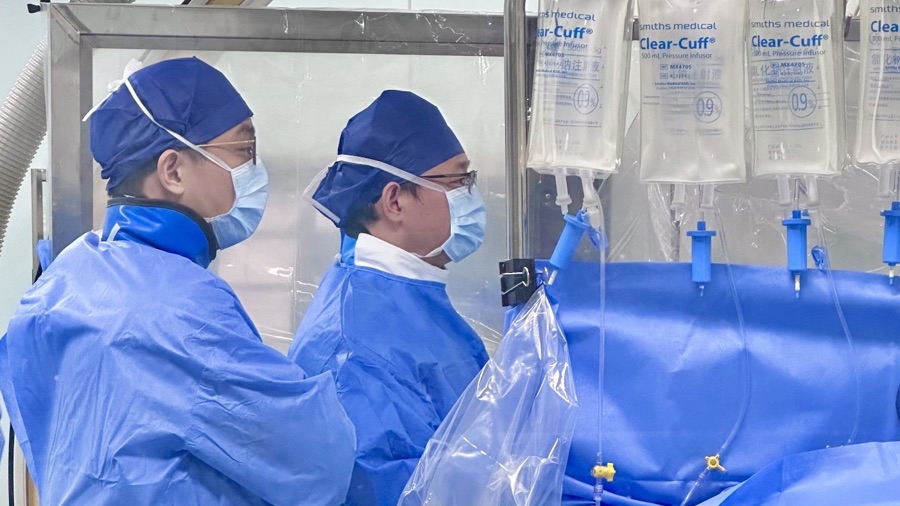
Dr. Gai Yanting's team performing emergency carotid stent implantation at Shanghai Donglei Brain Hospital.
Dissection
catheter
Site
Ambulation
After the Massage, Her Right Arm "Stopped Working"
Chen Rong (a pseudonym), a Shanghai resident, wanted nothing more than to relieve everyday fatigue. "I was exhausted, so I went for a relaxing neck and shoulder massage," she recalled. "The therapist pressed hard, but at the time I just thought that was part of the treatment."
Gradually, however, her right arm began to lose sensation. "My right arm felt as if it were filled with lead — I couldn't lift it at all. Then my right leg started to go numb, and the numbness spread so quickly that I could barely feel my leg. I also noticed I couldn't control my saliva; it was dripping from the corner of my mouth."
Realizing something was seriously wrong, Chen Rong went to a local hospital, where imaging revealed a vascular problem. She was then urgently transferred to Shanghai Donglei Brain Hospital.
Emergency CT scanning delivered a shocking diagnosis: her left internal carotid artery had developed a 6 cm arterial dissection — a tear in the vessel wall that was severely restricting blood flow. The brain was already showing early signs of infarction.
"This condition is like a tear in the blood vessel wall — as if a slice of bread had been roughly ripped apart. Blood flow was almost completely blocked, and the brain was beginning to show early signs of stroke."
A 0.6 mm Catheter Completed the "Vascular Embroidery"
Faced with this critical situation, Dr. Gai Yanting's team decided to perform DSA (digital subtraction angiography) to precisely locate the dissection and plan treatment.
"DSA accurately pinpointed the tear in the artery. We then performed carotid artery stent implantation for the patient," Dr. Gai explained.
During the procedure, the physicians inserted a microcatheter just 0.6 mm in diameter through the femoral artery in Chen Rong's thigh, navigating the complex vascular network to reach the lesion.
"The self-expanding intracranial alloy stent we implanted acts like a protective umbrella inside the vessel, pressing the torn arterial wall back together," Dr. Gai said. The mesh design also promotes new intimal growth over the damaged area. Within six months, the vessel can fully heal.
Minimally invasive key points: only a 2 mm puncture at the access site, and the patient was able to get out of bed six hours after the procedure.
Postoperative angiography showed that the previously blocked carotid artery had been restored to normal patency. "After surgery, the weakness and numbness in my right limbs gradually disappeared. I'm very grateful to Dr. Gai and the team!" Chen Rong said.
⚠️ Three "Danger Zones" You Should Never Massage Roughly
The carotid artery is like a "highway" connecting the heart to the brain. Its wall has three layers — similar to a sturdy sandwich. But when abnormal force is applied — such as a forceful massage or a violent head whip during sudden braking — the inner layer can tear. Blood then rushes into the wall, creating a "sandwich" pocket: this is an arterial dissection.
Carotid artery dissection is also an important cause of stroke in younger and middle-aged adults.
1. Carotid Triangle — Do Not Squeeze Violently
The artery lies only about 1 cm beneath the skin in this area. Forceful pressure here is effectively like pinching the brain's main supply line.
2. Atlantoaxial Joint Area — Do Not Rotate Excessively
Violent rotation can twist the vertebral artery like a wrung rope and, in severe cases, trigger stroke.
3. Around the Temples — Do Not Press Hard
The superficial temporal artery wall is as thin as a cicada's wing. Improper pressure can cause an intracranial hematoma.
About 5% of people have a congenital vascular defect. Avoid sudden neck twisting or excessive backward tilting in daily life, and always choose a licensed, qualified therapist before any massage.
🚨 After a Neck Massage, Seek Emergency Care If You Notice These Symptoms
Dr. Gai Yanting emphasized that if any of the following symptoms appear after neck massage, they should be treated as a red-light emergency signal requiring immediate medical attention:
- Sudden one-sided limb "power outage" — numbness or weakness
- Sudden facial drooping with uncontrollable drooling
- Neck pain accompanied by a thunderclap headache
- Blurred or double vision
From Near-Stroke to a Fresh Start
Thanks to rapid diagnosis and minimally invasive neurointerventional repair, Chen Rong escaped the worst outcome of a carotid dissection. Her story is a powerful reminder that relaxation therapies must respect anatomy — and that when vascular emergencies strike, time and expertise are everything.
Have Stroke Symptoms or a Recent Neck Injury?
Shanghai Donglei Brain Hospital provides 24/7 emergency neurovascular evaluation and minimally invasive treatment.
Request Emergency Consultation