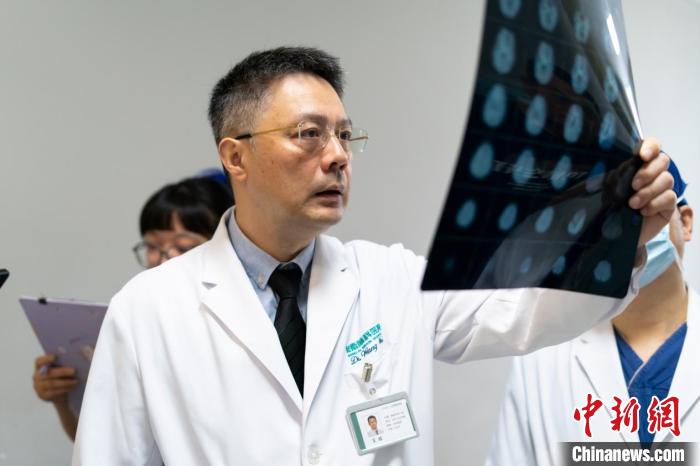
Dr. Wang Wei reviewing imaging during evaluation of a moyamoya disease patient at Shanghai Donglei Brain Hospital. (Image: China News Service)
In This Article
A "Drunken" Fall and Two Strokes in Five Months
When the illness first struck, Mr. Wang Jianqiang (a pseudonym), 63, felt as if he had been drinking: his body kept sinking, and he staggered from side to side as he walked. Within just five months, he suffered two consecutive cerebral infarctions, followed by slurred speech, memory decline, and limb weakness.
He sought help at many hospitals without success and was even told that surgery would require a six-month wait. Finally, at Shanghai Donglei Brain Hospital, a high-difficulty combined operation — carotid endarterectomy plus superficial temporal artery bypass — brought "living water" back to his parched brain.
At the first onset, the sudden "drunken feeling" made him lose control of his body. Hospital diagnosis: cerebral infarction, moyamoya disease, and vertebral artery stenosis. He initially received conservative treatment, and his symptoms improved for about two months. Then the second stroke struck, and imaging revealed new infarct lesions.
He underwent vertebral artery stent placement at a local hospital. But after the procedure, he found himself sluggish in reaction, and even simple daily conversation became a struggle.
Moyamoya Disease: When "Smoke Vessels" Take Over
In the clinic of Dr. Wang Wei, chief expert of neurosurgery at Shanghai Donglei Brain Hospital, a detailed cerebral angiography report revealed the true nature of Mr. Wang's condition: severe stenosis of the proximal carotid artery with distal occlusion, and where the artery's end should have been clearly visible, a dense tangle of disorderly, hair-thin vessels as wispy as smoke.
"This is moyamoya disease, a chronic progressive occlusive vascular disease. When the brain's main roads become impassable, the body, in an attempt to save itself, compensates by growing many tiny abnormal vessels. These vessels look like puffs of smoke on angiography. This is not just a blockage problem — it is an extremely complex case in which the compensatory mechanism is on the verge of collapse."
This compensation is extremely fragile. "Smoke vessels" supply blood inefficiently and unstably, and are the root cause of both cerebral infarction and cerebral hemorrhage. Combined with severe carotid stenosis, Mr. Wang's brain was in a state of severe "starvation."
This was also the root of his memory decline. Memory function depends on deep brain structures. The two strokes caused local brain cell necrosis, while chronic ischemia left the surviving neurons underpowered and "on strike."
🔬 Understanding Moyamoya Disease
- Chronic and progressive: Gradual narrowing of the arteries at the base of the brain.
- Compensatory "smoke vessels": Fragile collaterals that form like a net of smoke on angiography.
- Double danger: These vessels can trigger both ischemic stroke and brain hemorrhage.
- Symptoms: Transient dizziness, blurred vision, limb numbness, speech difficulty, and memory decline.
Two Problems, One Surgery: CEA + Bypass
Facing this complex condition, Dr. Wang Wei explained his surgical strategy: "Severe proximal carotid stenosis means the brain's vascular regulation is very poor and blood flow is seriously insufficient. During surgery, we must both open the proximal vessel and perform a distal bypass to guarantee blood supply to the brain."
The dual strategy:
- Step 1 — Carotid Endarterectomy (CEA): Remove the plaque from the proximal carotid stenosis and restore "main road" pressure.
- Step 2 — Extracranial-Intracranial Bypass: Bring a strong extracranial artery directly into the skull, building a "supply highway" to the ischemic brain region.
- Result: One operation resolving two core contradictions.
The surgery was completed smoothly. Postoperative review showed patent vessels and a marked improvement in blood flow to the ischemic brain region.
Recovery and Discharge
Two weeks after surgery, Mr. Wang was discharged smoothly, and his communication had become fluent again. The "living water" brought by the combined procedure continues to nourish his brain, protecting him from further strokes.
Patient Age
5 Months
Single Operation
Recovery & Discharge
Early Screening: The Key to Preventing Brain "Blackout"
Dr. Wang Wei warns that both moyamoya disease and arteriosclerotic stenosis do not form overnight. "A 63-year-old patient's vascular disease may have started more than a decade earlier."
⚠️ Warning Signals Often Mistaken for Something Else
- Transient dizziness or a brief blacking out before the eyes.
- Occasional limb numbness or difficulty speaking.
- These may last only a few minutes and are often mistaken for low blood sugar, cervical spondylosis, or fatigue.
For middle-aged and older people with hypertension, diabetes, or smoking habits, a routine physical examination that only includes neck ultrasound is not enough. A more comprehensive cerebrovascular evaluation should be performed, such as MRA (magnetic resonance angiography) or CTA. Early detection and early intervention are the key to preventing the brain from "losing power."
🏆 Restoring Flow, Restoring Life
Mr. Wang's successful treatment demonstrates the value of combined carotid endarterectomy and extracranial-intracranial bypass for complex cases of moyamoya disease with severe carotid stenosis. Through careful evaluation and a dual strategy in a single operation, the team at Shanghai Donglei Brain Hospital reopened the road his brain desperately needed.
For international patients seeking evaluation for moyamoya disease, carotid stenosis, or complex cerebrovascular conditions, the hospital provides comprehensive consultation services with multilingual support.
Seeking Treatment for Moyamoya or Carotid Stenosis?
Our international patient team offers free preliminary consultations, treatment planning, and travel coordination for overseas patients considering cerebrovascular surgery or stroke prevention care in Shanghai.