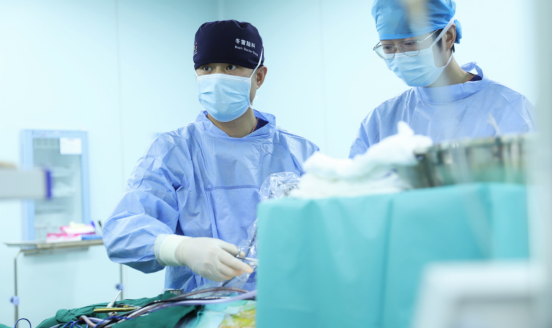
Dr. Zhang Xuejun's team operating at Shanghai Donglei Brain Hospital. (Image: Shanghai Donglei Brain Hospital)
Across Both
Hemispheres
All Four Tumors
Removed
Moving Again by
Post-op Day 3
Glioma —
Men Slightly More
Half a Month of Life and Death: Silence, Paralysis, and Four "Uninvited Guests"
The brain is the body's "general headquarters," commanding thought, speech, movement, and emotion. In 2025, World Brain Health Day (July 22) focused on the theme "control risk factors, promote brain health."
"My dad seemed to be 'stolen' from us — and so fast," said Wang Dandan (pseudonym), her voice choking. Half a month earlier, her talkative father, Mr. Wang Feng (pseudonym), had suddenly become withdrawn and slow to react. Before the family could recover from the shock, worse followed: he could no longer control his urination, his speech became incoherent, and finally the entire right side of his body stopped obeying him.
At Shanghai Donglei Brain Hospital, the MRI results were cold and cruel: four malignant gliomas across both hemispheres of the brain — three entrenched in the left frontal lobe, which governs thinking, emotion, and movement, and one lurking in the right frontal lobe. "When a tumor invades the frontal lobe's functional areas, a person becomes paralyzed, confused, and undergoes dramatic personality changes," explained Dr. Zhang Xuejun, Director of Neurosurgery at Shanghai Donglei Brain Hospital.
Looking at her father, Wang Dandan's heart twisted: "Four tumors, in such deadly positions — Dad is only 59. Is there still hope with surgery?"
Four "Time Bombs" Defused: A New Lease on Life
"Operating on both hemispheres and four tumors in functional areas in a single surgery carries extremely high risk — like clearing mines in the nervous system's 'forbidden zone.' It demands experience, feel, and judgment from the lead surgeon, plus seamless teamwork."
Dr. Zhang was frank about the core difficulty: gliomas tend to arise in functional areas, and the frontal lobe's neural networks are intricately intertwined. The team had to achieve total tumor resection while maximally preserving the functional integrity of every single nerve fiber.
After comprehensive evaluation and meticulous planning, Dr. Zhang Xuejun's team decided to perform a bilateral frontal lobe lesion resection. During the operation, the neuronavigation system provided precise positioning — a "high-definition map of the brain." Real-time intraoperative electrophysiological monitoring captured the brain's electrical signals: as the surgeons removed the tumors, they stimulated the surrounding nerves, recorded and analyzed the electrical signals produced by the neural tissue, and monitored the patient's responses — precisely identifying the "red lines" of functional areas and dynamically adjusting the extent of resection. This placed near-rigorous demands on the lead surgeon's experience and technique, as well as on neuronavigation and intraoperative electrophysiology.
In the end, thanks to extraordinarily fine, precise technique, all four tumors were successfully removed from the patient's brain. On the third day after surgery, Mr. Wang was already able to move his limbs slowly with assistance. Simultaneous speech rehabilitation training also helped him begin to regain his voice. The road to recovery is long, but hope has appeared. "Seeing him move and try to respond to us — it feels like… Dad is coming back," said Wang Dandan, a long-lost smile with tears in her eyes finally returning to her tired face.
Brain Health Day · Expert Insights
Paying attention to abnormal brain signals, practicing a healthy lifestyle, and seeking early diagnosis and treatment are the keys to protecting the body's "life center." For Brain Health Day, Dr. Zhang Xuejun offers an in-depth look at this "brain killer":
1. What is a glioma, and why is it so dangerous?
"It is the most common primary brain tumor, growing invasively through brain tissue like the 'roots' of a tree," Dr. Zhang Xuejun stressed. Its malignancy is high, it grows rapidly and recurs easily, quickly destroying normal brain tissue and causing severe consequences such as headache, vomiting, epilepsy, paralysis, aphasia, dramatic personality changes, and cognitive decline. Young and middle-aged adults — especially those aged 31–40 — are the most affected group, with men slightly more than women.
The exact cause remains a medical puzzle. However, long-term exposure to high-dose ionizing radiation (such as in certain occupations without protection) is a clear high-risk factor. In addition, certain viral infections (such as cytomegalovirus) and long-term heavy consumption of foods containing nitrites (such as cured meats and pickled vegetables) may also raise the risk.
2. The cornerstone of treatment: surgery — as early as possible!
"Once a glioma is diagnosed, surgery is the first choice — and the earlier the better," Dr. Zhang said emphatically. The tumor will not stop growing; delay only makes surgery harder and the prognosis worse. The core principle is maximal safe resection while preserving neurological function. After surgery, radiotherapy, chemotherapy, or targeted therapy is usually needed to delay recurrence as much as possible. "High-grade gliomas currently cannot be cured outright — they require scientific, long-term, comprehensive management."
3. Why was this operation "breaking into the forbidden zone"?
Multiple tumors (four) plus critical locations (functional areas of both frontal lobes). The surgery had to find a millimeter-level balance between "complete removal" and "function preservation," relying heavily on the lead surgeon's skill and experience as well as intraoperative navigation, electrophysiological monitoring, and other equipment.
4. Brain health: what can we do?
Brain health must not be neglected. Although gliomas cannot be fully prevented, a healthy lifestyle can lower the risk and help catch problems early:
- Avoid high-risk environments: avoid long-term exposure to high-dose ionizing radiation (strict protection is essential in certain occupations);
- Build healthy eating habits: reduce high-salt, high-oil, and pickled foods (containing nitrites), eat more fresh vegetables and fruits, and keep nutrition balanced;
- Regular routine, moderate exercise: get enough sleep, keep up moderate physical activity, and strengthen immunity;
- Control tobacco and alcohol: quit smoking and avoid excessive drinking;
- Heed the body's alarms: persistent worsening headache and dizziness, unexplained nausea and vomiting, sudden blurred vision, numb or weak hands and feet, unclear speech or difficulty understanding, dramatic personality or mood changes, sudden seizures, a cliff-like decline in memory — these may be the brain's "distress signals." Get checked promptly at a proper hospital's neurology department.
Key Takeaways for Patients and Families
Rapid personality change, incontinence, or one-sided weakness in a loved one is never "just stress" — get a head MRI promptly. Even multiple malignant gliomas in critical areas can now be removed in a single navigation-guided operation when performed by an experienced team. Early diagnosis remains the decisive factor: the earlier the tumor is treated, the better the outcome.
Worried About Glioma or Persistent Neurological Symptoms?
Shanghai Donglei Brain Hospital provides expert neurosurgical evaluation, head MRI diagnostics, neuronavigation-guided and electrophysiologically monitored glioma resection, plus postoperative radiotherapy-chemotherapy coordination and rehabilitation.
Request a Consultation