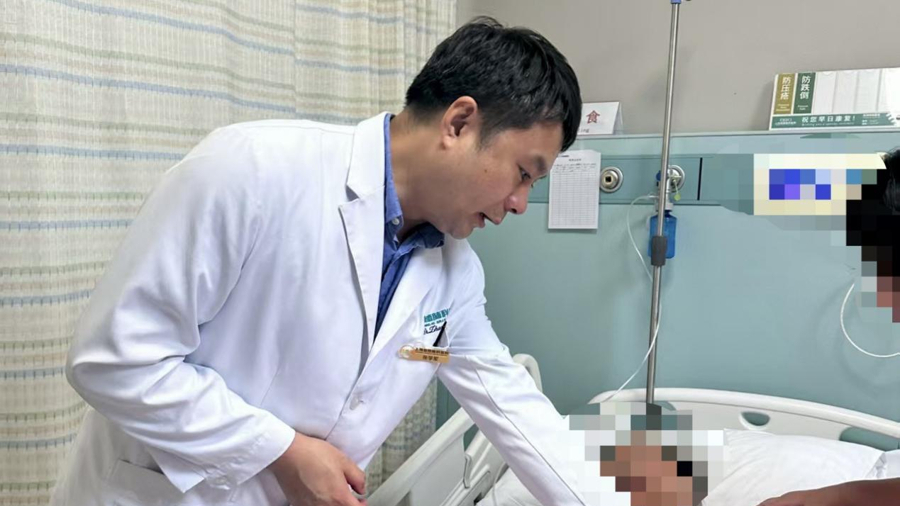
Dr. Zhang Xuejun at a patient's bedside at Shanghai Donglei Brain Hospital.
Grew
Undisturbed
Large for a
Craniopharyngioma
Window Above
the Eyebrow
High Surgical
Risk Profile
Two Decades of "Invisible Growth," Then a World That Went Dark
Recently, Shanghai Donglei Brain Hospital performed a high-difficulty minimally invasive resection for a patient in his seventies who had lived with a craniopharyngioma for twenty years — freeing him from the risk of blindness and long suffering, and returning him to a clear field of vision.
Mr. Chen (pseudonym), in his seventies, experienced a sharp decline in vision half a year ago. The world before his eyes grew increasingly blurred, until he could no longer make out the faces of his own family from one meter away. The cause traced back to a craniopharyngioma diagnosed twenty years earlier. Although he had relied on long-term traditional Chinese medicine to manage it, the tumor kept growing — to nearly 4 centimeters — severely compressing the optic nerve and surrounding critical brain tissue, accompanied by headaches, frequent night-time urination, and other symptoms that tormented him body and mind.
The craniopharyngioma sits in the "vital hub zone" of the skull base, adjacent to the optic nerve, the hypothalamus, and the pituitary gland. Although it grows slowly, over time it swells like an ever-expanding "balloon," squeezing and invading these extraordinarily delicate structures and triggering declining vision, endocrine disorders, and multiple other symptoms. Surgical resection is the fundamental treatment.
"A tumor nearly 4 centimeters across is already large for a craniopharyngioma. Its compression of the optic nerve and the hypothalamic-pituitary region is significant, and the symptoms are more severe."
Why the Standard Route Was Too Risky for This Patient
There was a problem: the patient was advanced in age, with hypothalamic dysfunction and a severe deficiency of pituitary hormones. The conventional "endonasal transsphenoidal approach" — entering through the nose — carries a relatively high risk of cerebrospinal fluid leakage and infection, and was not suitable for his physical condition.
After a comprehensive assessment of his age, the tumor's characteristics, his overall condition, and the potential risks, Dr. Zhang Xuejun's team designed a customized minimally invasive plan: the supraorbital lateral approach.
A "Tiny Window" Opened Above the Eyebrow
The surgery opened a bone window of only about 3 centimeters above and lateral to Mr. Chen's eyebrow ridge.
"This channel is like cleverly opening a tiny window in a solid fortress. It provides a direct path to the front and underside of the tumor, while maximally avoiding the vine-like network of nerves and vessels that threads through the skull base."
Through this small corridor, the team worked around the critical neurovascular structures and completely resected the tumor.
Outcome: After surgery, Mr. Chen's vision recovered significantly, his headaches disappeared, and symptoms such as frequent night-time urination and listlessness improved dramatically.
Individualized Precision: "Tailor-Made" Skull Base Surgery
Dr. Zhang Xuejun noted that this case fully demonstrates the importance of individualized precision medicine in skull base tumor treatment: "For elderly patients with reduced functional status, surgery must strike a balance between complete tumor resection and the preservation of neurological function — truly 'tailor-made' treatment."
Key Takeaways for Patients and Families
Craniopharyngioma is benign but strategically dangerous; progressive vision loss, hormonal disturbances, and chronic headache deserve prompt neurosurgical evaluation. Age alone is not a barrier to surgery — the right approach, matched to the patient's condition, can make even high-risk resection safe.
Concerned About a Skull Base Tumor or Failing Vision?
Shanghai Donglei Brain Hospital offers expert neurosurgical evaluation and customized keyhole approaches for craniopharyngioma and other skull base tumors, including for elderly and high-risk patients.
Request a Consultation