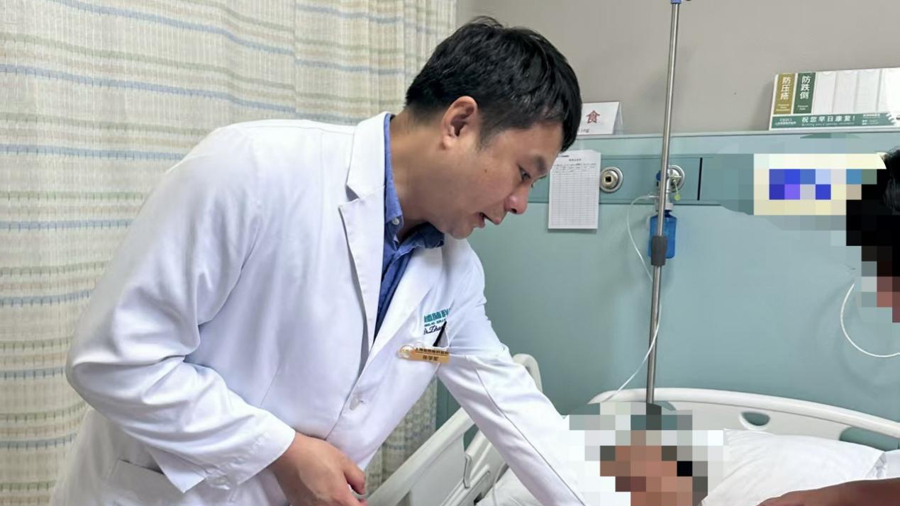
Dr. Zhang Xuejun at a patient's bedside at Shanghai Donglei Brain Hospital.
the Tumor
Since Age 7
Recurrence Over
11 Years
in the Sellar
Region
Achieved With
Nerves Preserved
A Life-or-Death Duel with the "Child Killer"
In a ward at Shanghai Donglei Brain Hospital, 18-year-old Xu Lei (pseudonym) slowly opened his eyes after surgery and saw his mother's face clearly. For a teenager who had battled a craniopharyngioma for 11 years, it was a long-delayed gift of fate. Five stubborn battles over 11 years — and this time, a total resection of the tumor brought his life a brand-new hope.
Xu Lei's fight began at age 7, when declining vision in his right eye accidentally exposed the "time bomb" hidden deep in a critical area of his brain: a craniopharyngioma. This intracranial tumor mostly affects children and teenagers. Although usually benign, it is exceptionally dangerous because it grows in the sellar region — the most central and fragile part of the brain, packed with the "command centers" that control vision, growth and development, body temperature, thirst, and hormone secretion. A tumor growing here is like an obstacle planted in the core hub of a precision instrument.
Over 11 years, Xu Lei endured hardships most people can hardly imagine: at 7, he underwent his first open surgery because of the vision loss in his right eye; because the tumor was not completely removed, it recurred repeatedly over the following decade. At 18 (in 2025) it returned yet again, now with unsteady walking, slowed reactions, and brief memory lapses — seriously disrupting his life and studies.
In August this year, he came to Shanghai Donglei Brain Hospital, where Professor Zhang Xuejun, Director of Neurosurgery, and his team performed his third open surgery for craniopharyngioma resection.
The Hardest Challenge: Surgery on a Recurrent Tumor
"Craniopharyngioma surgery is already known for its high difficulty and high risk. Surgery for a recurrent craniopharyngioma is harder still."
The tumor lies deep in the sellar region, surrounded by the hypothalamus (the life center), the pituitary gland (the master of hormones), the optic chiasm (the visual pathway), and the internal carotid arteries (the brain's main blood supply). The operative space is extremely narrow, and the precision required reaches 0.1 millimeters.
After each previous surgery, hard scar tissue formed as the wounds healed — like "super glue" — binding the tumor tightly to the surrounding vital nerves and vessels. "This is the greatest difficulty of recurrent surgery!" Dr. Zhang explained. The team had to separate and remove the tumor safely without injuring the critical neurovascular structures around it, especially the hypothalamus and major blood vessels — like carefully defusing a bomb in a ruin full of live electrical wires, every step fraught with danger.
Beyond that, the team had to strike an exceptionally difficult balance between pursuing complete tumor removal (to lower the recurrence rate) and maximally protecting neurological function (avoiding severe sequelae such as blindness, paralysis, cognitive decline, or endocrine collapse). For a recurrent patient, this choice is especially painful and critical.
Outcome: Facing Xu Lei's complex condition, Dr. Zhang's team drew up a meticulous surgical plan. With rich experience, refined microsurgical technique, and advanced equipment such as neuronavigation, they overcame the dense adhesions and completely removed the recurrent tumor. Even more remarkably, they preserved the important neurovascular structures the tumor had tightly enveloped. After surgery, Xu Lei's vital signs were stable — and the growth his puberty had paused may now resume.
Know the Enemy: Early Warning Signs of Craniopharyngioma
Craniopharyngioma can occur at any age but is most common in children and teenagers. Parents should pay close attention if a child or teenager shows:
- Vision problems without an obvious cause: declining vision, blurring, or visual field defects
- Abnormally slow growth: height and weight clearly lagging behind peers
- Excessive thirst and urination: drinking large amounts of water and urinating much more often and in larger amounts
- Persistent or recurring headaches and dizziness
- Listlessness and slipping grades: slowed reactions, poor concentration, declining school performance, memory decline
- Endocrine red flags: delayed puberty in teenagers, or sexual dysfunction in adults
For craniopharyngioma, surgical resection is the first-choice and core treatment. A recurrent craniopharyngioma can cause more severe neurological deficits — further vision deterioration or even blindness, and more serious endocrine disorders — so strict, regular postoperative follow-up is essential. Regular head MRI reviews are the key to catching a recurrence early!
"For children with craniopharyngioma, choosing an experienced and highly skilled surgical team not only determines whether the tumor can be effectively removed — it directly affects the child's lifelong quality of life, growth and development, and the boundless possibilities of the future. Precise surgical treatment is the key that opens the door to hope."
Benign Tumor, Dangerous Location
Craniopharyngioma is usually benign — but in the sellar region, "benign" never means "harmless." Recurrence after an incomplete resection is common, and every subsequent operation is harder than the last. Early detection, complete resection, and lifelong MRI follow-up are the three pillars of a good outcome.
Concerned About a Sellar Region Tumor or Recurrence?
Shanghai Donglei Brain Hospital offers expert neurosurgical evaluation, neuronavigation-assisted microsurgery, and long-term follow-up for craniopharyngioma and other skull base tumors.
Request a Consultation